Loading Disappointment: The Cruel Truth About Revisiting Your Favourite Childhood Games
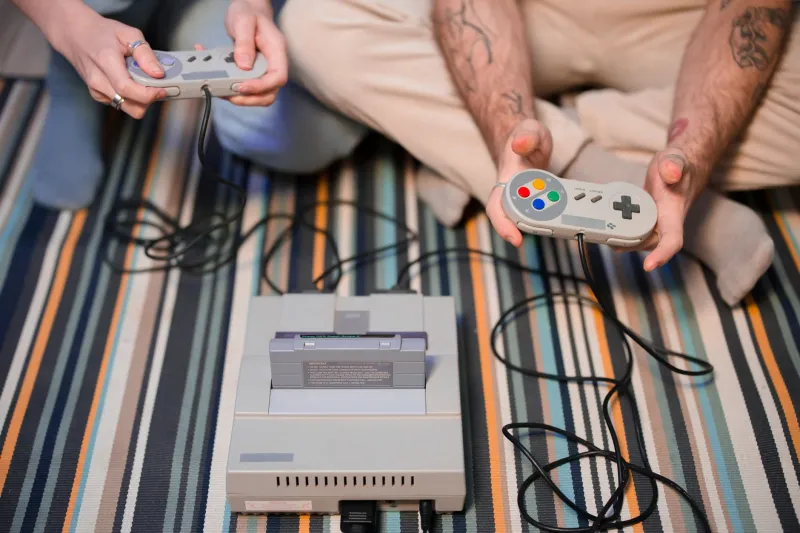
It always starts with such confidence. You have been telling people about this game for years. Possibly decades. You have described its genius to partners, friends, and anyone unfortunate enough to get trapped with you at a party. You have used words like "ahead of its time" and "genuinely groundbreaking" with the absolute certainty of someone who last played the thing in 1994 and has spent thirty years polishing the memory to a high shine.
Then you boot it up.
And within approximately four minutes, something has gone very wrong.
The Gap Between Memory and Reality Is Enormous and Filled With Mud
There is a well-documented psychological phenomenon called rosy retrospection, which is the tendency to remember past experiences more positively than they actually were. Scientists have studied it extensively. What they have not studied, because they presumably have more important things to do, is the specific variant that afflicts British gamers of a certain age — the absolute, unshakeable conviction that the games of their youth were brilliant, and the profound personal crisis that follows the discovery that they were, in many cases, absolutely not.
The Spectrum. The Amiga. The early PlayStation. The Mega Drive. Each of these platforms is home to a collection of games that exist simultaneously in two states: the game as it actually was, and the game as remembered by the people who played it between the ages of seven and fifteen. The gap between these two versions is sometimes a crack. Frequently it is a chasm. Occasionally it is so vast that you begin to question your own reliability as a witness to your own life.
Take Jet Set Willy. Classic, right? A British icon. Manic Miner's spiritual successor. Beloved by an entire generation. It is also an exercise in arbitrary death, invisible hazards, and controls that feel like you are steering a caffeinated hamster through a nightmare. The rooms are imaginative. The difficulty is not so much punishing as personally vindictive. And yet — the memory insists it was wonderful. The memory is lying.
Why We Remember Wrong
The explanation is not mysterious, even if it is a little deflating. When you played these games as a child, you had things you no longer have: time, patience, and absolutely no frame of reference for what games could or should feel like. You had not played a game with responsive controls, because responsive controls largely did not exist yet. You had not experienced a tutorial, because tutorials were considered a form of weakness. You died repeatedly and learned nothing and died again, and this was simply the texture of gaming, and you accepted it because you did not know there was anything to accept.
You also had something else: stakes. When you finally, after six weeks of trying, completed the third level of something impenetrable on your Amiga, that achievement was real and hard-won in a way that modern games — which are generally designed to make you feel competent rather than to destroy you — rarely replicate. The memory of the triumph is vivid. The memory of the preceding forty-seven hours of failure has been conveniently archived somewhere inaccessible.
The Specific Horrors That Await the Returning Nostalgist
Let us be specific about what actually happens when you revisit these games as an adult, because the catalogue of disappointments is rich and varied.
First, the controls. Modern games have spent thirty years refining the relationship between input and response until it is so smooth that you barely notice it. Old games — particularly anything from the 8-bit and 16-bit eras — control like you are sending instructions via telegram to someone who is only partially paying attention. There is lag. There is imprecision. There are jumps that feel like you are arguing with the physics engine rather than working with it.
Second, the save systems. Or rather, the absence of them. A significant proportion of the games that British gamers remember most fondly had no save function at all. You started from the beginning every time. This was considered normal. Returning to these games as an adult who has things to do and places to be and perhaps a job and some responsibilities, the absence of a save point feels less like a design choice and more like a personal affront.
Third — and this one is particularly brutal — the length. Games that felt enormous and inexhaustible in childhood are frequently completable in an afternoon by a competent adult. The sprawling adventure you remember exploring for months can be walked through in two hours once you know what you are doing. The world was not bigger then. You were just smaller.
The Magic Was Real, Though. Wasn't It?
Here is where it gets philosophically complicated, and where the easy cynicism of nostalgia-debunking starts to feel a bit cheap.
The games were genuinely worse by almost every measurable technical standard. The controls were worse. The graphics were worse. The save systems were worse or nonexistent. The difficulty balance was frequently deranged in ways that would be considered unacceptable today.
And yet.
The imagination required to fill in the gaps — to extrapolate a whole world from a handful of pixels, to invent narrative from the barest suggestion of story, to find meaning in mechanics that were barely functional — that was real. The communities that formed around sharing tips and secrets, in playgrounds and on telephones and through the letters pages of magazines, were real. The sense of discovery, of encountering something genuinely new, of being part of the first generation for whom this was possible at all — that was absolutely real.
The magic was not in the games exactly. It was in the encounter between the games and the people playing them, at a particular moment in history, with a particular set of expectations and a particular quality of attention. You cannot recreate that by booting up an emulator. The game is the same. You are not.
Go On Then. Play It Anyway.
None of this should stop you. The disappointment is worth it, not despite what it reveals but because of it. Returning to a beloved old game and finding it clunky and strange and much shorter than you remembered is not a loss. It is information about who you were, and how far both you and the medium have travelled.
The Spectrum classic that controls like a disaster is also a window into a version of yourself that had infinite patience and no standards and found genuine wonder in sixteen colours and a tinny beep. That person is worth visiting occasionally, even if the game they loved has not aged especially well.
Just maybe do not tell anyone else how good you remember it being. You will only have to explain yourself later.