Cold Feet, Warm Memories: The Sacred Madness of the British Midnight Console Launch
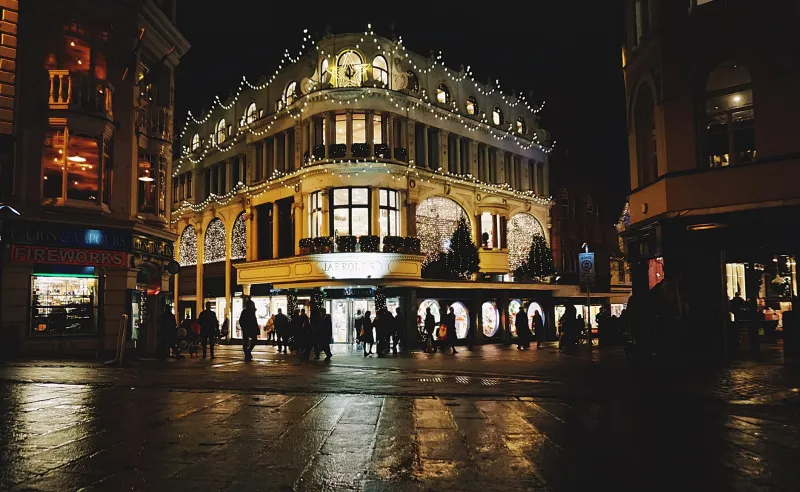
Let's set the scene. It's November. Obviously it's November — it's always November. The rain isn't falling so much as hovering aggressively at face height. You're wearing a coat that seemed adequate at 9pm and is now a tragic joke. The person in front of you has a camping chair, a flask of Bovril and the look of someone who has done this before and has absolutely no regrets. The queue stretches back past the Greggs and round the corner towards the car park.
You are, by every rational measure, having a terrible time.
You are also, somehow, having the time of your life.
The Queue as Cultural Artefact
Britain has always had a complicated relationship with queuing. We mythologise it, practise it with almost religious dedication, and secretly enjoy the social levelling that occurs when everyone — regardless of status, wealth or how warm their house is — has to stand in the same sodden line.
The midnight gaming launch took this national characteristic and weaponised it. Here was a queue with stakes. With purpose. You weren't just waiting for a bus or shuffling forward at a post office. You were waiting for the future. For a machine that would change everything. For a piece of hardware that cost roughly two months of pocket money and would be obsolete in seven years, but right now, at half eleven on a wet Wednesday outside a GameStation in Wolverhampton, represented the absolute pinnacle of human achievement.
Dave, 38, remembers queuing for the PlayStation 2 outside an Argos in Leicester in October 2000. "I was sixteen. Me and my mate got there at six in the evening. There were already about forty people in front of us. It was raining. We'd brought a two-litre bottle of Fanta and a bag of Quavers and we thought that was sufficient preparation for an eight-hour queue."
It wasn't. But that's not the point.
"The point," Dave says, "is that by midnight I knew everyone around us. We were swapping games we'd completed, arguing about whether Metal Gear Solid was overrated, getting chips from the kebab shop across the road. When they finally opened the doors it felt like we'd earned it. Like we were part of something."
The Retail Staff Who Survived
On the other side of those glass doors, of course, were the people who actually had to manage the chaos — and their memories are somewhat less warmly nostalgic.
Sarah, who worked in a major games retailer in Manchester from 2002 to 2009 and has asked us not to name the chain for reasons she describes as "ongoing trauma", handled midnight launches for the Xbox, the PlayStation 3, and the Nintendo Wii, among others.
"The Wii launch," she says, pausing for effect. "I still have dreams about the Wii launch. We had stock for about sixty units. There were easily two hundred people outside. We had one security guard. One. His name was Terry and he was sixty-three years old and he'd been expecting a quiet night."
She describes the moment the doors opened as "like releasing pressure from a valve, except the valve was full of grown adults who'd convinced themselves that a motion-controlled tennis game was worth hypothermia."
And yet — and this is the thing — she loved it.
"There was this energy. You'd have a dad who'd queued for six hours to get a PS3 for his kid's Christmas, and when you handed it to him he looked like he'd won something. Actually won something. Not just bought a box. You don't get that with a download."
The 3am Refresh Era
The landscape shifted gradually. Stock-checker websites appeared. Then Twitter bots. Then Discord servers dedicated entirely to alerting members when a particular SKU flickered back into availability on the Currys website at an ungodly hour.
The queue didn't disappear — it migrated indoors, onto sofas, into dressing gowns.
The PS5 launch in November 2020 — timed, with spectacular cosmic irony, to coincide with a global pandemic — became the defining moment of this new era. Millions of British gamers sat in virtual queues on retailer websites, watching progress bars that moved with geological slowness, refreshing pages until their fingers ached, only to be told that stock had sold out before they reached the front.
Jamie, 29, from Leeds, describes the experience with the thousand-yard stare of a man who has seen things. "I was in the GAME queue online for two hours. Got to the front. Crashed out. Went to Argos. Went to John Lewis. Went back to GAME. By 4am I was refreshing StockInformer on my phone while lying on the kitchen floor because I'd fallen asleep on the sofa and didn't want to wake my partner."
He didn't get a PS5 until March 2021. "It arrived in a brown box from Amazon. Just... appeared. No drama. No queue. No memory attached to it at all."
He's still slightly sad about it.
What Actually Got Lost
Gaming historians — yes, they exist, and they're brilliant — will tell you that the midnight launch was never really about the hardware. It was about the ritual. The shared experience of anticipation that transformed a consumer transaction into something that felt, however briefly, like a communal event.
Dr. Eleanor Marsh, who researches gaming culture at a UK university and is very patient with journalists asking her about PS2 queues, puts it plainly: "The physical launch queue created a moment of genuine shared identity. You were part of a cohort. You experienced the same cold, the same boredom, the same excitement. That's the kind of thing that builds communities and creates lasting memories. A digital pre-order confirmation email doesn't do that."
She's right, and somewhere in the back of your mind, you already knew she was right.
The Screen Loads
The midnight launch isn't entirely dead. Some retailers still run them for major releases. Some independent gaming shops have made them a genuine event — warm, staffed by enthusiasts, occasionally involving actual hot drinks. The culture hasn't vanished. It's just become rarer, which makes it feel more precious.
But the mass, slightly chaotic, completely British experience of standing in a car park in November with strangers who are all equally committed to a shared act of magnificent consumer lunacy — that's fading. Being replaced by convenience. By efficiency. By the perfectly sensible but entirely soulless experience of a brown box appearing on your doorstep.
Convenience is great. It really is. But it doesn't give you a story.
And the queue? The queue always gave you a story.