Stamp Cards, Steel Books and Stubbornness: UK Retailers Fighting for Your Gaming Wallet
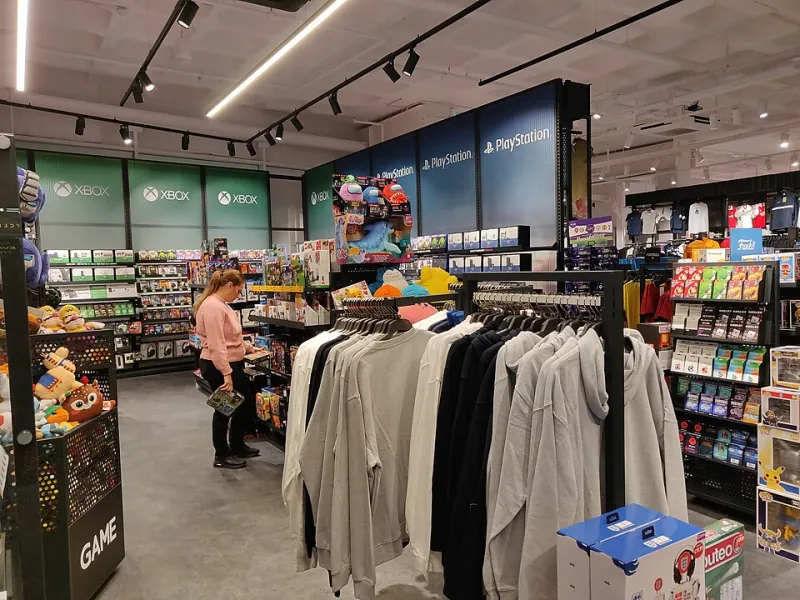
Photo: Tim Sheerman-Chase, CC BY 2.0, via Wikimedia Commons
In 2025, buying a video game should be simple. You open an app. You click a button. The game appears. No queuing, no parking, no conversation with a shop assistant who wants to tell you about the pre-order bonus for a game you didn't ask about. Clean, frictionless, done.
And yet. Somehow. British people are still walking into shops to buy physical games. Not in the numbers they once did — let's not pretend otherwise — but in numbers substantial enough that certain retailers are still very much in the game, so to speak. The question is: why? And the answer, it turns out, involves steelbooks, loyalty points, the peculiar British attachment to owning a thing you can hold, and a surprising amount of innovation from the chains you probably wrote off years ago.
The State of Play
The UK physical games market has been contracting for years. Digital now accounts for the majority of game sales by volume, a shift accelerated by lockdowns, faster broadband, and the gradual disappearance of the cultural stigma around not owning a disc. The generation currently growing up with gaming may never own a physical copy of anything, and they appear entirely unbothered by this fact.
But physical retail hasn't collapsed. It's contracted, consolidated, and — in some cases — reinvented itself with considerably more imagination than anyone expected. GAME, which has spent much of the past decade looking like a business in its final chapter, has pivoted towards experience retail: tournament spaces, gaming cafés within stores, pre-order events with actual atmosphere. Whether this is a genuine strategic shift or an elaborate form of denial depends slightly on which branch you visit.
Supermarkets, meanwhile, have quietly become significant players. Tesco, Asda, and Argos between them account for a meaningful chunk of physical game sales, largely because they're already where people are going anyway, and because a game next to the reduced bread is harder to ignore than a digital storefront notification.
The Collector Edition Industrial Complex
If there is one tactic that physical retail has deployed with genuine effectiveness, it is the collector's edition. And Britain, it turns out, is extremely susceptible to this.
We are a nation that likes stuff. Specifically, we like stuff that comes in a box, looks impressive on a shelf, and signals to visitors that we are serious about the things we are serious about. The collector's edition — with its artbook, its steelbook case, its fabric map that will never be unfolded, its resin figurine of dubious artistic merit — speaks directly to this instinct.
Retailers have learned to use exclusivity as a lever. GAME has historically offered exclusive editions not available elsewhere. ShopTo built a loyal following partly through competitive pricing and partly through reliable delivery of pre-orders that actually arrived before the release date, which sounds like a low bar but proved to be a meaningful differentiator. Zavvi has cornered a particular niche with limited edition releases that appeal to collectors who are also interested in the aesthetic of their shelf, not just the contents of the disc.
The steelbook, specifically, deserves recognition as one of the cleverest bits of retail psychology in recent memory. It is a game case made of metal. It costs more. It contains the same disc. People love it. Genuinely love it. They will buy a game they already own digitally in order to have the steelbook version on their shelf. This is not rational behaviour, but retail has never really been about rational behaviour.
Loyalty Schemes and the Points Illusion
Every major UK retailer with a gaming offer has some form of loyalty programme, and the range of quality is extraordinary. At one end, you have schemes that offer genuine value — meaningful points accumulation, exclusive early access, member pricing that actually beats the standard RRP. At the other end, you have schemes that exist primarily to collect your data while offering rewards so modest they function more as a polite gesture than an actual incentive.
Britain has a complicated relationship with loyalty cards. We collect them with enthusiasm, forget to use them with equal enthusiasm, and then feel a small, irrational surge of satisfaction when we finally redeem points for something that cost us more in brand loyalty than it was worth in cashback. Gaming retail loyalty schemes tap directly into this psychological loop.
The schemes that are genuinely working tend to share common features: they're integrated across digital and physical, they offer rewards relevant to gaming (store credit, early access, bonus content) rather than generic retail discounts, and they communicate with members in ways that feel targeted rather than spammy. The ones that aren't working tend to offer a stamp card energy in a world that has moved on from stamp cards.
Who's Actually Winning?
Honestly? The picture is more complicated than the 'physical retail is dead' narrative allows for.
Independent gaming shops have had something of a quiet revival, particularly in university towns and cities with strong gaming communities. These shops — the ones that stock retro hardware, host local tournaments, and employ staff who will genuinely talk to you about games for twenty minutes — have found an audience that the big chains struggle to reach. They're not competing on price. They're competing on experience and community, and in certain postcodes, that's working.
Supermarkets will continue to sell games as long as games sell, because supermarkets sell everything and have no particular feelings about it either way. Their advantage is footfall and convenience, which are durable advantages.
The specialist chains face the most interesting strategic challenge. They need to be something that Amazon and the PlayStation Store cannot be — and the answer, increasingly, seems to be physical spaces where gaming is an experience rather than just a transaction. Whether that's enough to sustain the high street gaming shop for another decade is genuinely unclear.
What is clear is that the obituary for physical gaming retail in Britain has been written several times already, and each time, something stubbornly refuses to die. Which is, when you think about it, a very British outcome indeed.