Controllers, Crisps and Cracking Company: The Rise of the Great British Gaming Night In
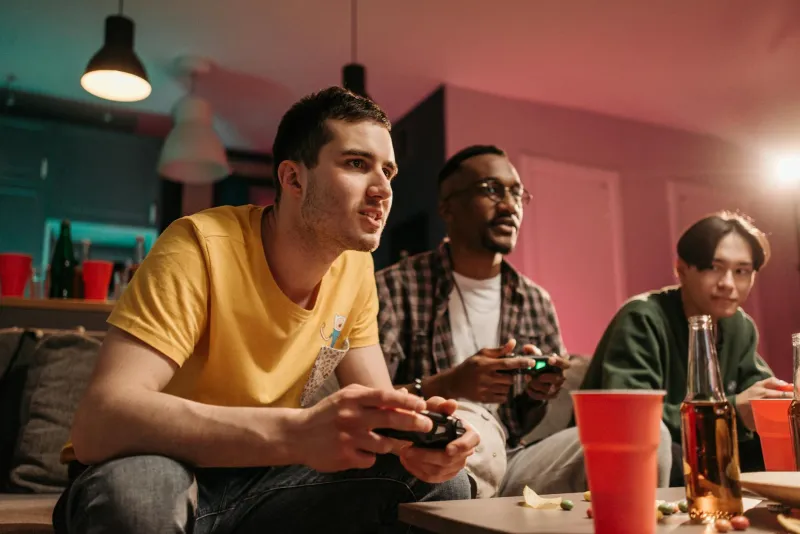
Controllers, Crisps and Cracking Company: The Rise of the Great British Gaming Night In
Cast your mind back, if you will, to the last time you went to the cinema. You'd booked in advance because apparently spontaneity is now a premium feature. You'd paid somewhere between £14 and £18 for the privilege of sitting in a room where someone three rows back was eating nachos with the energy of a person who has never once been asked to keep it down. You left slightly underwhelmed, considerably poorer, and with the specific kind of exhaustion that only comes from trying to have a nice time in public.
Now consider the alternative. Your living room. Your snacks. Your mates. A game that everyone can play, or at least cheerfully fail at together. No booking. No travel. No negotiating over who's getting the Uber.
This is the pitch for the Great British Gaming Night In — and it's landing with an increasingly receptive audience.
The Numbers Behind the Vibe Shift
This isn't just anecdotal. The cost-of-living squeeze that's been reshaping British leisure habits since 2022 has accelerated a shift that was already quietly underway. UK households are scrutinising discretionary spending with the intensity of a GCSE maths exam, and entertainment is firmly in the crosshairs.
A night at the cinema for two, including snacks and travel, routinely clears £60 in most UK cities. A sit-down meal out for four can easily reach £150 before anyone's ordered a second round. Against that backdrop, the economics of a gaming night are almost embarrassingly compelling. A game you already own, a few bags of crisps, a couple of supermarket meal deals, and you've got an evening that costs less than one cinema ticket and generates considerably more genuine interaction.
UKie, the trade body for the UK games industry, reported that gaming now reaches over 60% of the UK adult population. The image of gaming as a solitary, teenage pursuit has been quietly retired. The people organising gaming nights are in their late twenties, thirties, and forties. They have mortgages and strong opinions about cheese boards. They are, in other words, exactly the demographic that used to fill restaurants on Friday nights.
The Games That Make a Night
Not all games are created equal for social occasions, and choosing the right one is genuinely half the battle. Nobody's inviting their work friends round to watch them grind through a forty-hour RPG. The sweet spot is games that are immediately accessible, visually entertaining even for spectators, and forgiving enough that someone who hasn't touched a controller since the PlayStation 2 era doesn't spend the entire evening staring at a loading screen.
Overcooked! 2 remains the gold standard for cooperative chaos — a game that will test your friendships in the most gleefully stressful way imaginable. Four people trying to coordinate a kitchen that is, variously, on a hot air balloon, split across two moving platforms, or afflicted by some other culinary catastrophe generates the kind of collective screaming that you genuinely can't manufacture in any other context.
It Takes Two is brilliant for pairs and works brilliantly as a spectator sport for others in the room — inventive, funny, and surprisingly moving in ways that sneak up on you.
Jackbox Party Pack (any of them, honestly — the seventh and eighth are particularly strong) is the nuclear option for mixed groups where not everyone is a regular gamer. It runs through phones as controllers, requires zero gaming experience, and produces the kind of genuinely unhinged moments that get referenced for months afterwards.
Mario Kart 8 Deluxe needs no introduction. If you have a Switch and more than one person in the room, this game is legally required.
For groups who want something with a bit more competitive edge, Rocket League rewards spectating beautifully, and EA FC remains the game that somehow everyone has an opinion about regardless of whether they've played it in the past year.
The Snack Spread Is Having a Moment
Here's a development that nobody predicted but everyone should have seen coming: the gaming night snack table has become a genuine aesthetic and social event in its own right.
A scroll through the relevant corners of social media reveals gaming nights where the spread is almost — almost — the main attraction. Themed evenings where the snacks match the game (a Stardew Valley night with homemade jam and vegetables, a horror game session with appropriately grim-looking food, a Mario Kart tournament with a full build-your-own-nacho station) have moved from novelty to established format.
This is, when you think about it, extremely British. We have always found ways to make food the centrepiece of any social occasion. We've simply relocated the venue from a restaurant with a two-drink minimum to a living room floor covered in cushions.
The practical advice here is simple: go grazing rather than formal. Sharing platters, dips, anything finger-food adjacent. Bowls over plates. Things that can be eaten one-handed while the other maintains a death grip on a controller. A good cheese selection elevates any gaming night from good to genuinely memorable, and this is not a hill we're prepared to come down from.
Themed Evenings: Committing to the Bit
For the truly dedicated, the themed gaming evening is the pinnacle of the format. Pick a genre, a franchise, or even a decade, and build the entire evening around it.
A retro night — dragging out an old console or loading up a retro compilation — works brilliantly because it's both nostalgic and genuinely surprising to anyone who hasn't played those games in years. The difficulty curves of 1990s games are, it turns out, absolutely savage, and watching a room full of adults be comprehensively defeated by a 32-year-old platformer is a reliable source of entertainment.
A horror game night works differently — one person plays, everyone else watches and offers advice that is approximately 40% useful and 60% deliberately terrible. The social dynamic of a horror game spectating session is its own distinct pleasure.
A tournament evening, complete with a bracket drawn on the back of an envelope and prizes that are entirely symbolic, turns any multiplayer game into an event. The competitiveness is real, the stakes are low, and the arguments about whether that last goal counted will continue long after everyone's gone home.
The Smartest Entertainment Pivot of the Decade
There's a version of this article that frames the gaming night in as a consolation prize — the thing you do when you can't afford to go out. That framing is wrong, and it's worth saying so directly.
The best gaming nights aren't inferior nights out. They're a different kind of social experience entirely — more intimate, more interactive, more genuinely connected than sitting in a darkened cinema or shouting over music in a bar. You learn things about people when you play games with them. You laugh at different things. You collaborate, compete, and occasionally discover that your most mild-mannered colleague is absolutely ruthless at Mario Kart and has clearly been hiding this for years.
In a cultural moment where social anxiety is high, where going out can feel like a logistical and financial ordeal, and where the best experiences increasingly tend to be the unplanned, low-pressure ones, the gaming night in isn't a compromise.
It's the upgrade.
Now go sort out a snack spread. The lobby's already open.