Ceefax, Cheat Codes and Saturday Morning Chaos: When Telly Taught Britain How to Game
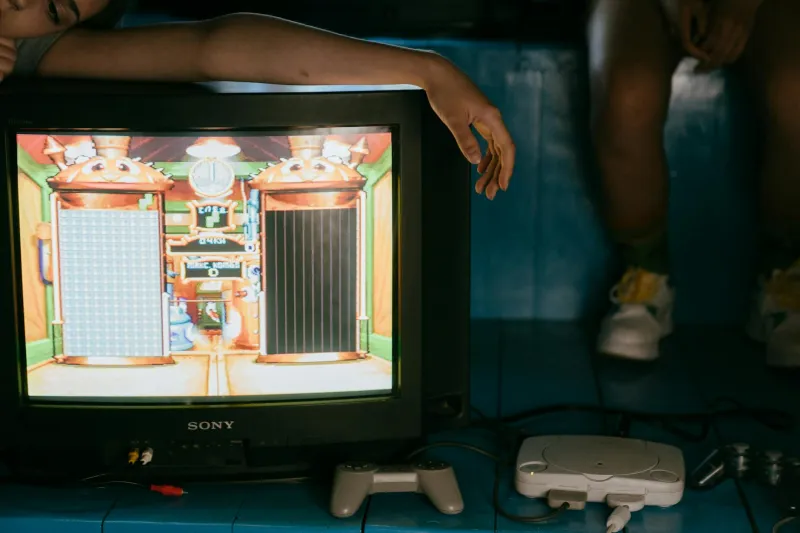
Long before streaming services and YouTube tutorials, there was a sacred ritual that shaped an entire generation of British gamers. Every Saturday morning, millions of kids would plant themselves in front of the telly, bowl of cereal in hand, ready to absorb everything they needed to know about the weird, wonderful world of video games. This wasn't just entertainment – it was education, delivered with the kind of chaotic energy that only British children's television could muster.
The Gamesmaster's Floating Legacy
It all started with a disembodied head floating in space, dispensing gaming wisdom with the authority of a digital oracle. Gamesmaster, which launched in 1992, didn't just review games – it created the template for how British kids would think about gaming for the next three decades.
Sir Patrick Moore's celestial presence lent an almost academic gravitas to discussions about Sonic's spin dash technique or the optimal strategy for Street Fighter II. Here was a proper astronomer, a man who'd spent his career studying actual celestial bodies, taking video games seriously enough to appear as a cosmic gaming guru.
"Gamesmaster made gaming feel legitimate," recalls Tom, now 35, who religiously watched every episode. "When Patrick Moore was giving you tips on Mortal Kombat fatalities, you knew gaming wasn't just kids' stuff anymore."
The show's challenges were legendary – watching some poor sod attempt to complete Ecco the Dolphin while Dominik Diamond provided sardonic commentary was peak British entertainment. Win or lose, these segments taught kids that gaming was about more than just playing; it was about performing, about rising to challenges, about the beautiful agony of public failure.
Bad Influence and the Art of Digital Rebellion
If Gamesmaster was the respectable face of gaming telly, Bad Influence was its rebellious younger sibling. Launched in 1992 and fronted by Andy Crane and later Violet Berlin, the show had an anarchic energy that perfectly captured the underground spirit of '90s gaming culture.
Bad Influence didn't just show you games – it showed you how to break them. Cheat codes weren't just useful tips; they were acts of digital rebellion, ways to subvert the established order and bend virtual worlds to your will. The show's infamous "Cheats and Hints" segment became essential viewing, with kids frantically scribbling down button combinations that promised infinite lives or secret levels.
"The show made cheating feel cool," remembers Sarah, a 38-year-old graphic designer. "It wasn't about making games easier – it was about discovering hidden depths, unlocking secret potential. Very British, really – finding the back door when the front door's locked."
The programme also pioneered the art of gaming journalism for kids, with reviews that were genuinely informative rather than just promotional fluff. This was where British kids learned to be critical consumers of gaming media, to look beyond the hype and ask the important questions: "But is it actually any good?"
Live & Kicking's Chaotic Generosity
By the mid-'90s, Saturday morning TV had evolved into something magnificently chaotic. Live & Kicking, with its three-hour live format and barely controlled energy, became the perfect vehicle for gaming content that felt immediate, urgent, and slightly dangerous.
The show's gaming segments had an improvisational quality that reflected how most kids actually experienced games – not through careful study, but through frantic experimentation and shared discovery. When Andi Peters or Emma Ledden introduced a new game, it felt like they were letting you in on a secret, sharing something they'd just discovered themselves.
But Live & Kicking's real gaming legacy lay in its giveaways. Those CD-ROMs tucked into magazines, the phone-in competitions, the promise that you could win an actual console just by knowing which button made Mario jump – this was where British kids learned that gaming was about community, about shared experiences and collective excitement.
"I never won anything," admits Mark, a 34-year-old teacher, "but just the possibility that I might win a Game Gear or a stack of Mega Drive games made Saturday mornings feel electric. It was like the lottery, but for kids."
The Ceefax Connection
Before the internet made gaming information instantly accessible, there was Ceefax – the BBC's teletext service that became an unexpected lifeline for gaming-obsessed kids. Page 647 was sacred ground, offering reviews, tips, and previews delivered in that distinctive blocky text that made everything feel official and important.
"Ceefax reviews were gospel," says Dave, a 41-year-old software developer. "If a game got a good score on page 647, that was it – you were pestering your parents for it until Christmas. The text might have looked like it was written by a robot, but somehow that made it more trustworthy."
The service's gaming content had a uniquely British sensibility – dry, understated, occasionally sarcastic. A bad game wouldn't be savaged; it would be dismissed with the kind of polite brutality that only British criticism can achieve. "Graphics are adequate. Sound is present. Overall: disappointing." Devastating.
The Cultural Architects
These shows didn't just report on gaming culture – they actively shaped it. They established the idea that games were worthy of serious discussion, that cheating was a legitimate strategy, that difficulty was something to be celebrated rather than avoided. They created a generation that expected games to be challenging, innovative, and slightly subversive.
More importantly, they established gaming as a fundamentally social activity. Even when you were playing alone, you were part of a community – the kids who'd watched the same shows, learned the same cheats, shared the same references. Saturday morning TV created a common language for British gamers, a shared cultural foundation that still influences how we talk about games today.
The Modern Void
So what's replaced this cultural institution? YouTube channels and Twitch streams offer infinitely more gaming content, but they lack the communal experience of Saturday morning TV. When everyone watched the same shows at the same time, gaming culture felt cohesive, shared. Now, with endless choice and personalised algorithms, that sense of collective discovery has largely disappeared.
"My kids get their gaming content from about fifteen different YouTubers," observes Lisa, a 39-year-old parent and former Bad Influence devotee. "They know way more about games than I ever did, but they don't have that shared cultural reference point. There's no modern equivalent of everyone knowing the Contra code."
Some attempts have been made to recapture that Saturday morning magic – CBBC's occasional gaming segments, online shows trying to recreate the anarchic energy of '90s kids' TV. But the media landscape has fragmented beyond repair. The days when a single show could introduce an entire generation to gaming culture are gone.
The Lasting Legacy
Perhaps that's not entirely a bad thing. Modern gaming culture is more diverse, more inclusive, more sophisticated than anything Saturday morning TV could have produced. But there's something to be said for the way those shows approached gaming – with genuine enthusiasm, healthy scepticism, and an understanding that the best games are the ones that bring people together.
They taught British kids that gaming wasn't just about escapism or competition – it was about discovery, community, and the joy of sharing something brilliant with people who understood why it mattered. In an age of infinite content and algorithmic recommendations, that feels like wisdom worth remembering.
So next time you're watching a gaming stream or reading a review online, spare a thought for those chaotic Saturday mornings when British kids learned everything they needed to know about gaming from a floating head, a rebellious presenter, and the promise that somewhere in those pixels lay adventure, challenge, and the chance to be part of something bigger than themselves.
Now, who remembers the cheat code for infinite lives in Contra? Up, up, down, down, left, right, left, right, B, A, start. Some things never leave you.